Robot designed for FAST TASK CHANGEOVERS
Features
Built-in AI integrator
Replace weeks of integration work and the integrator bill.
Powered by frontier models from Anthropic and OpenAI, the built-in AI integrator can:
Adapt the gripper and tooling for each task and prepare files for 3D printing.
Write and test programs based on advanced computer vision algorithms.
Control the robot directly to perform tasks.
Move the robot to collect training data for small, task-specific local models.
How to use
Types of tasks
Advanced automation with computer vision
(Bin picking, inserting connectors, handling rigid parts, pick-and-place)
Benefit: Faster setup for classical automation
Input: Briefly describe the task in free form. Dimensions and a 3D model are helpful. Use the teleoperation kit to quickly demonstrate the required waypoints.
Output: The AI integrator scans the setup and helps write classical automation code using advanced computer vision for object detection, pose estimation, and motion execution.
Tasks that require reasoning during execution
(Workspace cleanup, sorting, performing a task from a text prompt)
Benefit: Handle new task variations without reprogramming
Input: Briefly describe the task in free form.
Requires more tokens.
Output: The AI integrator will control the robot directly, analyzing the current scene and reasoning about the next step. No code needed. Can be slow.

Complex repetitive motions
(operations with an object in a fixed holder, painting, sanding)
Benefit: Program complex trajectories in seconds
Input: Use the teleoperation kit to record complex motions in seconds. The robot can then repeat them identically.
Requires a teleoperation kit and human operator training.
Output: The robot repeats the recorded motion. Small variations are handled by the gripper’s compliance mechanism.

Deformable objects with high variability
(Zip ties, wire handling, film threading, variation in material properties)
Benefit: Automate tasks that were previously impractical to automate due to too many possible states
Input: Demonstrate an example motion using the teleoperation kit. Add a text description with relevant dimensions, distances, and other key parameters.
Requires a teleoperation kit and human operator training.
Output: The AI integrator moves the robot to collect training data and sets up the continuous learning pipeline for the task.


Features
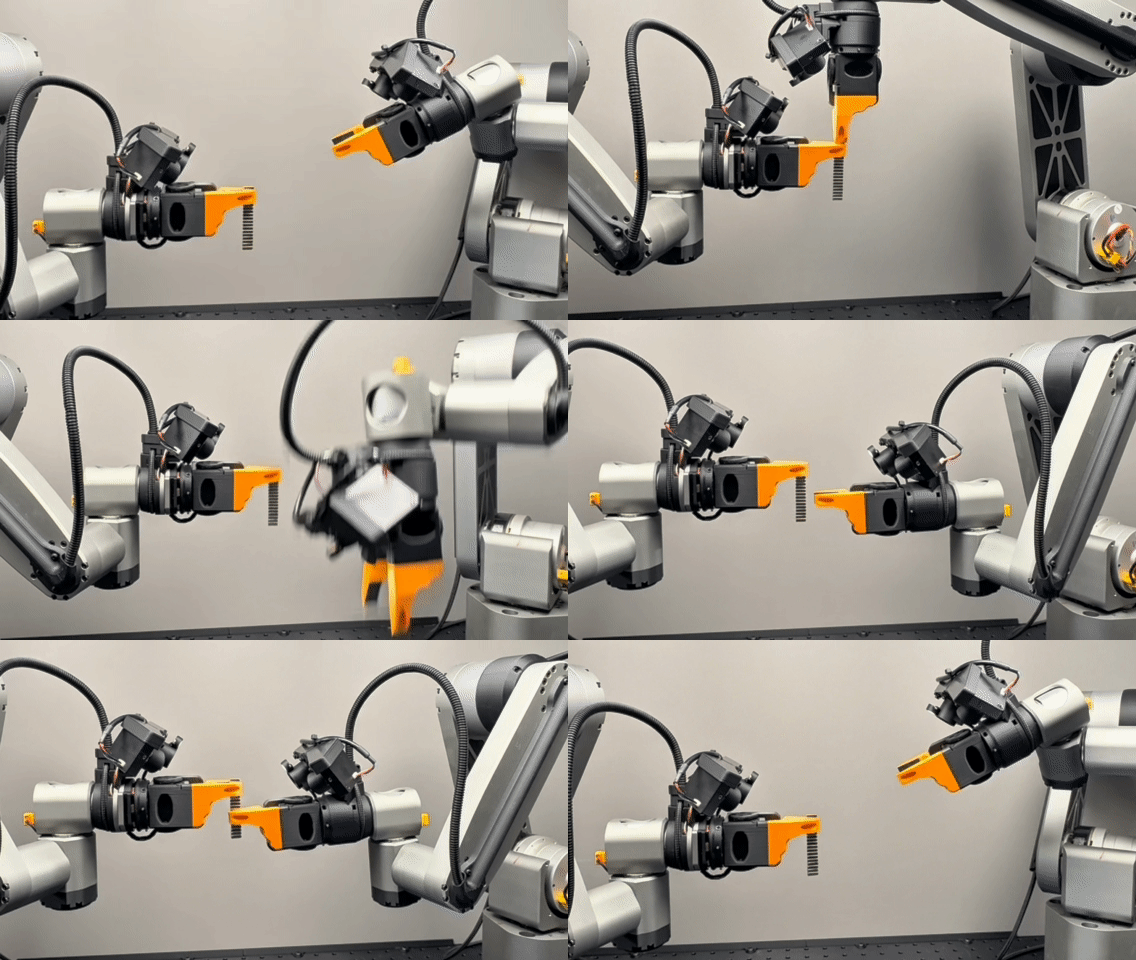
Hot-swappable grippers
Multi-step tasks
Our hot-swappable gripper system lets the robot use different tools and grippers within a single task. Place them in dedicated holders, and the robot can automatically switch between them as it works.
.gif)
Specs
Dimensions (W × D × H): 63 × 35.4 × 33.5 in / 160 x 90 x 85 cm
Weight: 176 lb / 80 kg
Expected Lifetime: 30,000 Hrs
Payload (fixed gripper): 3 kg
Reach: 622 mm
Degrees of Freedom: 6 axes
Pose Repeatability (ISO 9283): 0.02 mm
Typical TCP Speed: 1m/s
I/O Ports: Digital Input (DI): 2• Digital Output (DO): 2• Analog Input (Al): 2• Analog Output (AO)
FAQ
Do I need to pay for anything after purchase?
You pay for the Anthropic/OpenAI tokens needed for training and reconfiguring the setup. Once the robot is configured and running the task with local models, you don't pay for usage, since a 5-year license for all local models is included in the price.
Where is the data stored and processed?
We use Cloudflare for data storage, Modal for training, and Fly.io for fleet management. All are US-based companies. Model inference runs locally. We can also set up a fully local setup by agreement.
Can I use different robot arms, have a different box size, or use it without the box?
Yes, we don't have technical limitations on arm size or a requirement to use the frame around the robot. The frame is useful for consistent lighting and installation reliability. Currently, we support Fairino arms, which have a wide range of sizes. We can add support for specific robot arms on request.
risks and limitations
We work with frontier AI models that are improving very quickly, but using them still comes with some limitations. Some tasks can be automated well out of the box, others might require human input or some iteration to get right, while some might be too complex for it yet.
Start simple. We recommend starting with simpler tasks and increasing complexity as you get familiar with the system.
Prompts matter. Task success can depend on how the task is described and prompted.
Models keep improving. With each new generation of frontier models, the assistant becomes more capable.
30-day money-back guarantee. After the robot is fully delivered, you have 30 days to try it. If it doesn't meet your expectations, you can return it for a refund.
products
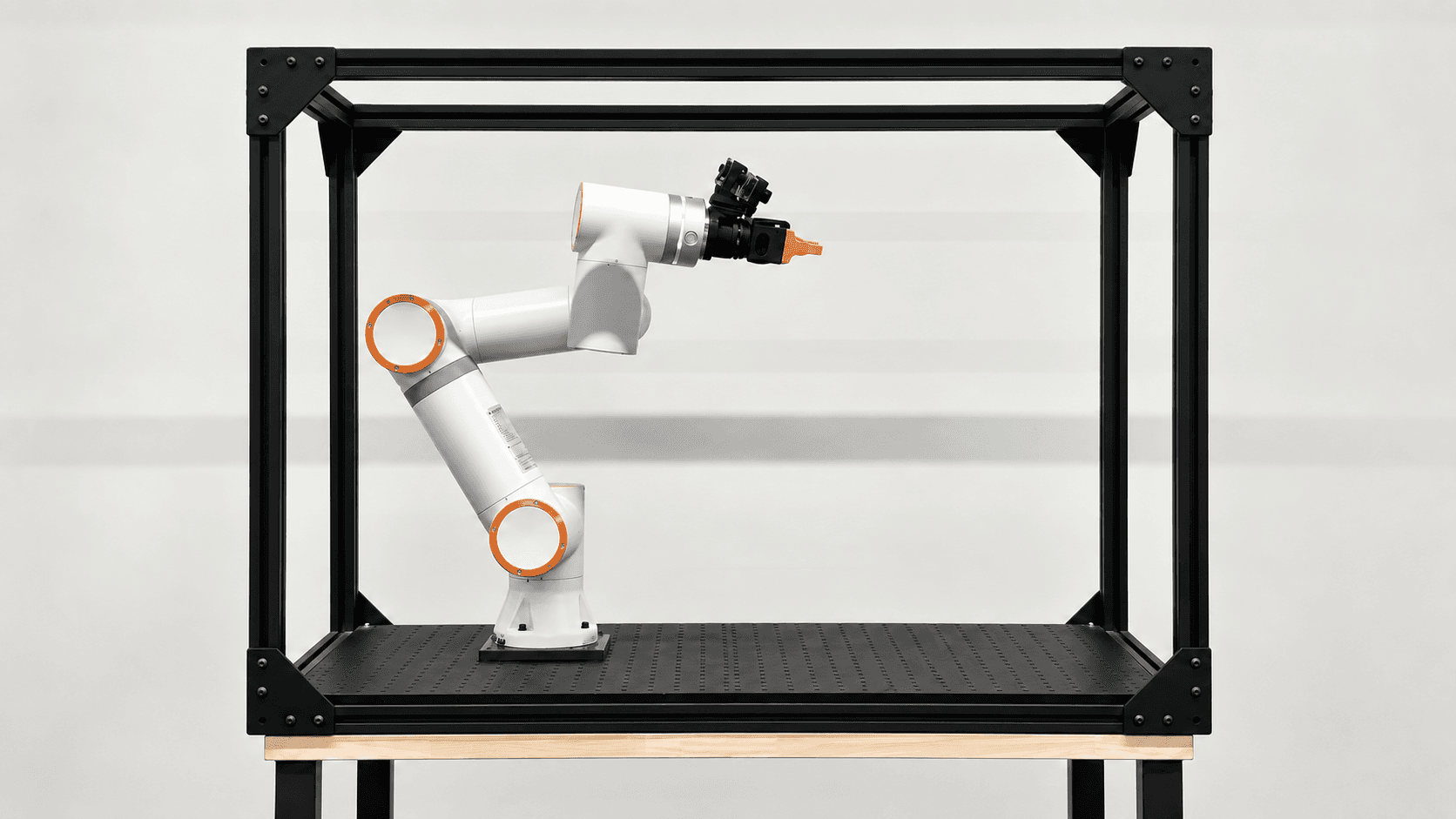
microfactory single
Starting from:
$11.950
One arm robotic cell
1x Fairino FR3 industrial robot arms. Installed and configured.
1x gripper with built-in compliance and a hot-swap mount for precise operations
2x cameras
Control box
Optical breadboard
Overhead lighting
Box-shaped frame
30-day money-back guarantee

microfactory double
Starting from:
$21.900
Two-arm robotic cell
2x Fairino FR3 industrial robot arms. Installed and configured.
2x gripper with built-in compliance and a hot-swap mount for precise operations
4x cameras
Control box
Optical breadboard
Box-shaped frame
Overhead lighting
30-day money-back guarantee

microfactory Array 8
Starting from:
$94.900
Eight arm robotic array
8x Fairino FR3 industrial robot arms. Installed and configured.
8x gripper with built-in compliance and a hot-swap mount for precise operations
16x cameras
Control box
Optical breadboard
Box-shaped frame
Overhead lighting
30-day money-back guarantee